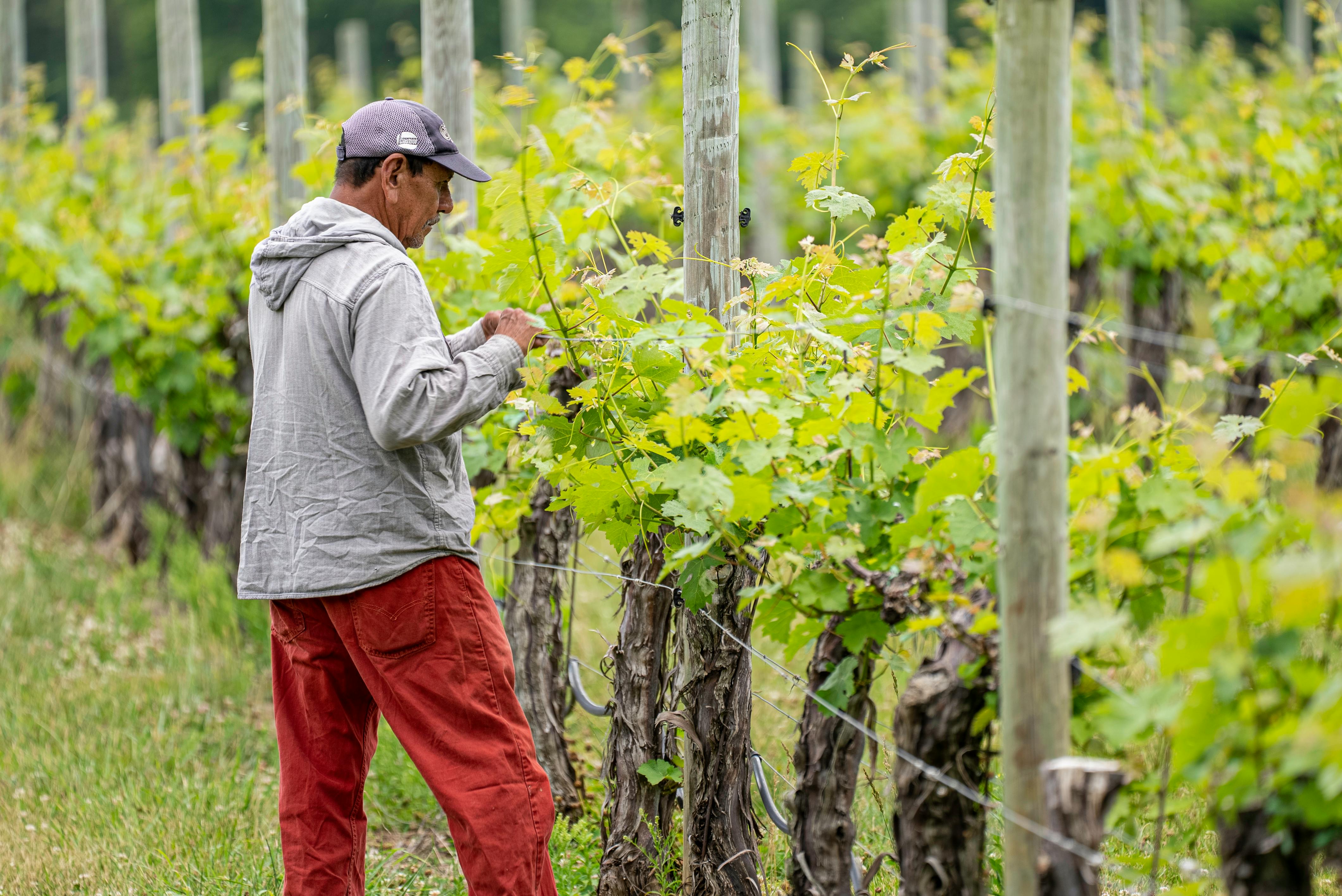
For the kingdom of heaven is like a master of a house who went out early in the morning to hire laborers for his vineyard. After agreeing with the laborers for a denarius a day, he sent them into his vineyard. And going out about the third hour he saw others standing idle in the marketplace, and to them he said, ‘You go into the vineyard too, and whatever is right I will give you.’ So they went. Going out again about the sixth hour and the ninth hour, he did the same. And about the eleventh hour he went out and found others standing. And he said to them, ‘Why do you stand here idle all day?’ They said to him, ‘Because no one has hired us.’ He said to them, ‘You go into the vineyard too.’ And when evening came, the owner of the vineyard said to his foreman, ‘Call the laborers and pay them their wages, beginning with the last, up to the first.’ And when those hired about the eleventh hour came, each of them received a denarius. Now when those hired first came, they thought they would receive more, but each of them also received a denarius. And on receiving it they grumbled at the master of the house, saying, ‘These last worked only one hour, and you have made them equal to us who have borne the burden of the day and the scorching heat.’ But he replied to one of them, ‘Friend, I am doing you no wrong. Did you not agree with me for a denarius? Take what belongs to you and go. I choose to give to this last worker as I give to you. Am I not allowed to do what I choose with what belongs to me? Or do you begrudge my generosity?’ So the last will be first, and the first last.
-Matthew 20:1-16
Parable Meaning
The master is God the Father, the laborers are believers in Christ, and the foreman is Jesus. The vineyard represents all good work. The day has a couple meanings: the life of a person and the time from Jesus’s resurrection until the second coming.
Since the day represents a lifetime, the denarius being a day’s wages means everyone receives the same income. All believers, regardless of when in their life they become one, earn the same reward of eternal life. In the afterlife, all people are on equal footing between each other as they are all without flaw or blemish, made to continue working for the kingdom of heaven.
After receiving their pay, the early laborers complain to the master about the late laborers receiving the same pay. However, the laborers had already made a deal with the master. God has made a deal with believers: follow Christ and have eternal life. When this happens at a young age, believers will work a long time in the present earth relative to a person who accepts Christ at an old age. Also, early Christians suffered much persecution (laboring in the heat) so that the gospel would be spread. Their reward is the same as those who live today.
Work Vehicle – Pay for Work
Each worker went from being idle to working for pay in the parable. In fact, the eleventh hour workers told the master “no one has hired us” as the reason for their idleness. They are all ready and waiting for the opportunity of fruitful work. People are made for work!
What is interesting though is the master offered everyone a day’s wages regardless of when they start. Since working a vineyard is a laborious job, everyone is not being paid for their hours. They are not being paid for a certain output either like number of branches trimmed or rows maintained. Instead, everyone receives the same pay regardless of when they started working. Note, it is not that they receive the same pay regardless of what they do; everyone is working.
There are very few contemporary examples of this kind of arrangement. One possibility is helping setup a concert and everyone receives free admission, but the income here isn’t a day’s wages. The closest arrangement is some kind of employee ownership or profit sharing arrangement. When all employees receive the same benefit regardless of how long they have worked there, it is an image of this example.
Adopting Technology
Another close representation of this parable is the impact of technology on work. Technology is any device that facilitates, improves, or otherwise enhances work or enjoying fruit. Computers are often described interchangeably as “technology,” but this is far too narrow of a scope. Nearly everything people make incorporates technology, including the thing being made.
One major goal of technology is reducing the amount of labor necessary to accomplish a task. Weaving used to be a very high-skill, labor intensive industry. Some basic developments in weaving will be used to demonstrate how technology caused people to work less to accomplish more.
Before looms, weaving would be done with a needle and thread as a kind of knitting. To make a large sheet of cloth it takes a very long time. The loom facilitated a much faster weaving process and made countless patterns possible. Mechanized textile mills further automated the weaving process making the wide availability of cloth possible today.
If one considers the wages from the parable as the output of work, then pre-loom weavers were the first hired. It took them a day to make a piece of cloth. With a loom, maybe it takes half of a day to make one piece of cloth. With the textile mill, it could take one hour. However, instead of just making the one piece, the technology is used to make more of the good.
Another impact of technology is for early adopters. When people begin using a new technology, it is difficult, expensive, and inefficient. They spend many more hours trying to make it work than when technology is more mature.
Early cell phones were bricks (almost literally). They were carried around in a briefcase. People using them accomplished the same thing as today: making and receiving phone calls without a wire. However, they had a much higher burden to carry them, paid much more money to use them, and had lower quality audio and latency.
Should an early cell phone adopter be resentful of current cell phone users? They both accomplish about the same work, but the early adopter had to work harder to use it. Even though the work is harder, the early worker was able to pave the way for the later adopters to enjoy. As long as technology improves, future workers will always have it better off. What is important is to work well within one’s resources.
Leave a Reply